

Greenwashing in the spray paint industry: which brands really drive a green transition?
“When spray paint brands are preaching that they’re saving the planet, how can you tell the truth from the hype?”
Sustainable spray paint is becoming a hot topic for artists, agencies, and brands, but clear, comparable information is still rare. Some spray can manufacturers and brands talk about being eco-friendly or climate neutral, cutting emissions, yet few share enough data to prove it. It’s a lot of talk and good intentions, but thanks to EU regulation and the Green Claims, which are being replaced by the Empowering Consumers Directive (EU) 2024/825, it is set to come into effect on September 27, 2026, and will ban unsubstantiated environmental claims.
At The Aerosol Alliance, we work towards transparency while sharing knowledge. Measurable impact backed by solid data instead of vague claims.
From the streets to climate impact
Spray cans are more than creative tools; they are also products with climate, health, and waste footprints that stretch from sourcing raw materials to disposal. For muralists, graffiti writers, and corporate art buyers, it raises a basic question: what is the impact of this work on the climate and on people’s health? The most sustainable option will always be to paint less or switch to lower-impact solutions. And we have covered this topic at large, so if you want, you can jump to our head over and take a deep facts page regarding the impact, production, use, and end-of-life of spray paint.
What is greenwashing?
Greenwashing is the practice of giving a false or misleading impression of the environmental benefits of a product, service, or company. It includes everything from “green” packaging on an unchanged product to marketing stunts that distract from the real footprint. Typical greenwashing examples in creative industries include “100% eco” claims without any supporting life cycle data, or statements about “saving CO2” that are vague, misleading, or based on unfounded information, with no method or numbers behind them.
As a concrete case or challenge, I, as a professional ESG consultant, observed this: one brand claims massive CO2 savings but publishes no underlying methodology, while another brand provides detailed life cycle assessments and verified numbers. Both talk about being sustainable, but only one lets you actually check the math. As a result, it is impossible for consumers to compare across the brands and have a common baseline, so to speak.
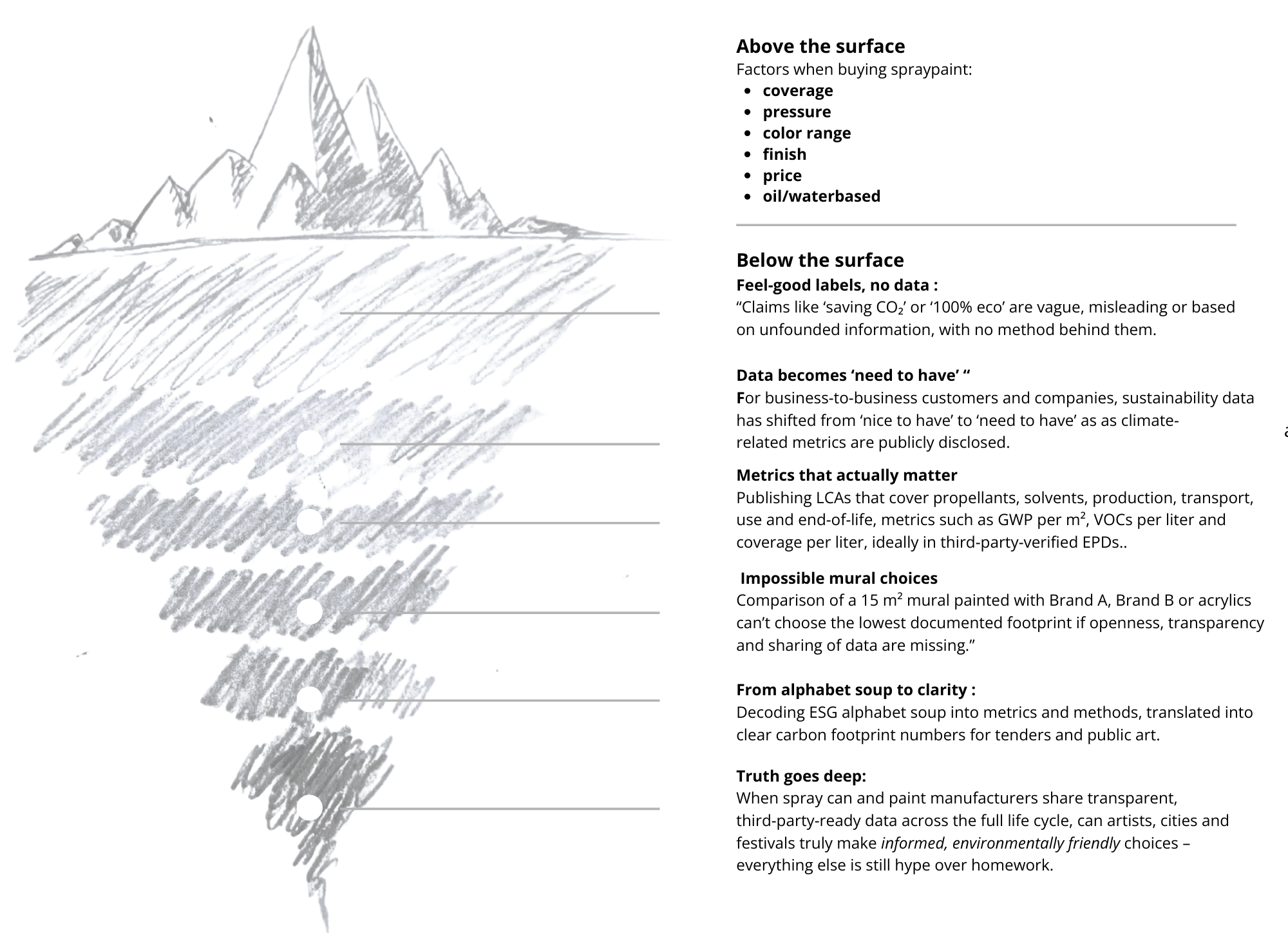
From ESG alphabet soup to practical choices
As a professional ESG advisor since 2019, working with clients that serve large business-to-business customers, it has become clear that sustainability data is no longer just a “nice to have”; it’s a “need to have.” Large companies, if they fall within certain criteria, are disclosing publicly climate-related metrics aligning with EU rules on reporting and green claims.
Inside the European Union, lawmakers are tightening the rules around green claims to protect consumers and reward genuine sustainability work. EU green claims especially aim to make sure that when a brand talks about being “climate-neutral,” “low carbon,” or “environmentally friendly,” the claim is:
- Based on measurable, life cycle-based evidence.
- Comparable across products and brands.
- Transparent about the methods and assumptions used.
- For spray can manufacturers, this means ESG (Environmental, Social, and Governance) buzzwords are no longer enough. They need to report their carbon footprint using Life Cycle Assessment (LCA) as a methodology and be prepared for their sustainable spray paint claims to be challenged if data is missing or weak.
Methodology: brand A vs. brand B? – truth or hype?
The premise was that I, on behalf of a client within the industry, wanted to compare a mural produced with Brand A spray cans, Brand B spray cans, or acrylic/wall paint and present the results to their client. In this manner, the client’s customer could, based on data, decide which climate footprint their new work, spanning 15 m², should have and choose the lowest documented footprint. Spray paint brand A, spray paint brand B, and acrylics C, but since the willingness, the openness, the transparency, and a sense of sharing was not in place, it became, at this point, due to impartial data, an impossible task.
The Aerosol Alliance works with artists, mural curators and producers, and sustainability advisors to move from slogans to numbers. The core idea is simple: if you want to avoid greenwashing, you need metrics and transparent methods. For spray paint, key metrics include:
- GWP per square meter of painted wall (kg CO2-equivalents) or per used can.
- VOC emissions per liter
- Coverage per square per liter of paint.
This could be a way forward:
- Define the functional unit (for example, a 100 m² mural lasting 15 years).
- Request climate data and documentation from different spray can brands and from alternative materials used to produce the mural.
- A full LCA, including raw materials such as: propellants and solvents. And covering the production, transport, use, and end-of-life of the product.
- Environmental Product Declarations (EPDs) or similar third‑party verified documents.
- If every spray paint brand claims to be Mother Teresa or Gandhi, who should I, as a consumer, believe?
- Check whether the used methodology is published, consistent, and third‑party reviewed.
- Translate the data into clear carbon footprint numbers that clients can use when choosing materials for tenders, open calls, and permanent installations.
Reliable information is providing sustainable choices
In real art projects, one spray can manufacturer may publish a clear methodology, explain how changes in propellant or packaging cut some emissions, and offer downloadable documentation. Another may use similar sustainability messages but reveal no methods or underlying figures. On the surface, both appear to be green leaders; in practice, only one can be meaningfully compared and trusted.
This lack of comparability is one of the most damaging greenwashing examples for the aerosol world. It muddies the water, prevents fair ranking of brands, and pushes the burden back onto the consumer or artist, who has to decode marketing language without access to real data. At The Aerosol Alliance, we are in the process of uncovering the secrets and decoding the business lingo. And trying to turn the complex wildstyle of abbreviations into a simple blockletter throwie. But we need your help and input!
What we are doing is merely the first lines on The Aerosol Alliance global wall - sketching up, but you, the reader, the ambassador, can contribute ideas for fills, details, extra layers, and shout-outs.
As an artist, you pick your tools.
When it comes to coverage, color range, and price, what about the climate footprint?
Artists already evaluate spray cans by coverage, pressure, color range, finish, and price. The next step is to add sustainability and transparency as active criteria. The lines below could perhaps inspire you the next time you shop for cans:
- Does this brand publish lifecycle data for its supposed sustainable spray paint line?
- Is there a clear EU green claims‑ready methodology behind their CO2 savings?
- Do they share information about worker safety, health impacts, and waste systems?
Examples of climate-conscious walls and festivals
The Aerosol Alliance has already put these principles into practice by helping create climate-conscious walls and events, where the climate footprint of the spray cans used was measured and discussed openly. These projects show that it is possible to align the culture and aesthetics of graffiti and street art with credible climate action, instead of treating sustainability as an afterthought.
We have published, to our knowledge, the world’s first climate footprint report of a graffiti and street art festival (published in 2024, based on 2023 data), collaborated with the International Meeting of Styles (online article), attended and presented at global trade fairs for the aerosol and packaging industry (presentation slide deck), and have two highly detailed podcasts session. The first was with Toy Division (episode #105), titled: Take Your Empty Cans With You. And the second podcast with Elliot O’Donell’s (AskewOne), called Muralism.
With global temperatures rising and climate-related risks increasing, artists can integrate climate action into daily practice: choosing brands that measure, document, and reduce their footprint, reusing and recycling cans where possible, and questioning vague green labels.
Call to Action: Separating truth from hype
The spray paint industry is at a crossroads. If every brand claims to be the hero of the green transition, no one can tell who is serious and who is not. But if the sector aligns around clear EU green claims principles to empower consumers to make informed and environmentally friendly choices when buying products, everyone wins: artists, buyers, manufacturers, and the climate.
The Aerosol Alliance invites:
- Spray can and spray paint brands & manufacturers who want to share their data and improve their products.
- Artists, crews, and festivals who want to pilot climate-conscious walls and events.
- Agencies, cities, and corporations that need reliable, comparable climate metrics for murals and public art.
Reach out to The Aerosol Alliance to discuss sharing your product’s environmental data correctly. Without risking green washing claims. Together we can move the entire industry toward transparency and genuine climate action.