

What really happens to empty spray paint cans? Closing the loop: visiting DESPRAY Environmental
"End of the line: Following an empty spray paint can after the art is finished."
Empty spray cans are the forgotten end of graffiti, street art, and muralism. Once the wall is finished and the photos are taken, the cans often disappear from the story. But from an environmental perspective, that’s where the most complex part begins.
At The Aerosol Alliance, we talk a lot about responsibility across the full life cycle of spray paint. From raw materials and production to use and End-of-Life. Recently, we took a small but important step in that direction by visiting DESPRAY Environmental in Almelo (NL), a specialized recycler focused on aerosol can waste.
This visit was not about celebrating a perfect solution. It was about understanding what actually happens when spray cans are handled properly. Learning how the process works and to talk about why this step is so rarely taken.
Why aerosol cans are difficult to recycle
Spray paint cans are not ordinary packaging. Even when “empty,” they usually still contain:
- residual paint or solvents
- pressurised propellant gases
- mixed materials (steel, aluminium, plastics, coatings)
Because of this, many conventional recycling facilities cannot safely process aerosol cans. As a result, they are often:
- incinerated,
- landfilled,
- or rejected entirely from recycling streams.
This is not a theoretical issue. Across Europe and beyond, limited infrastructure and unclear disposal guidance mean that a share of used spray paint cans never enters the correct waste treatment system.
Visiting DESPRAY Environmental: what happens behind the scenes
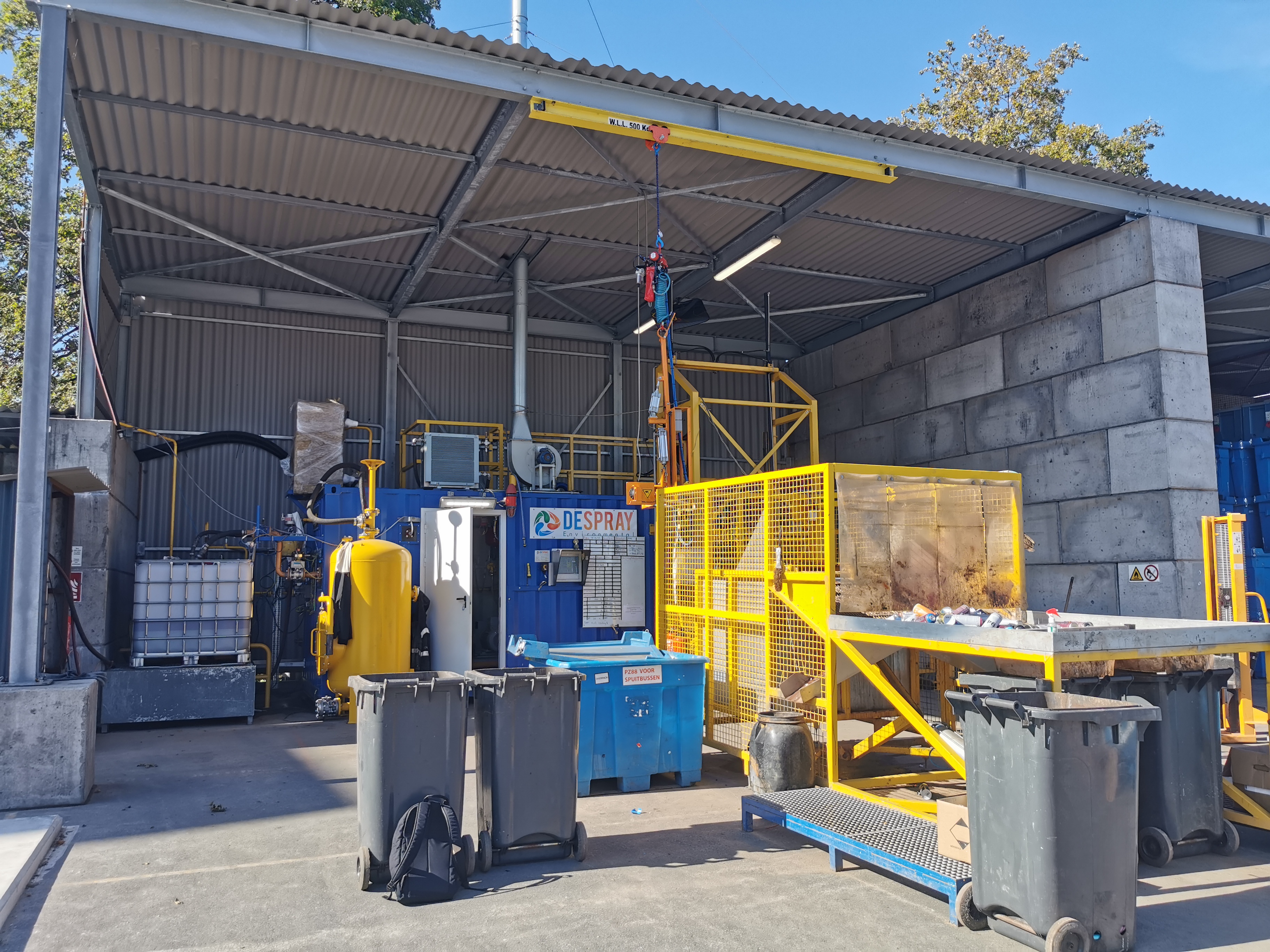
DESPRAY Environmental operates a specialized industrial process designed specifically for aerosol waste. During our visit, we followed the journey of a batch of used spray paint cans collected during the Bijlmer Boogie Graffiti Jam.
Their process focuses on controlled depressurisation and material separation, allowing different waste streams to be handled safely and responsibly. In practice, this means:
- residual gases are captured and treated,
- leftover paint and solvents are extracted,
- metals and plastics are separated into clean material streams.
These streams can then be sent to appropriate downstream recycling or treatment facilities, instead of being incinerated or landfilled. What stood out to is not just the technology, but the intent: aerosol cans are treated as a system problem, not as inconvenient waste.
A small batch making a big difference

The number of cans we brought to DESPRAY was modest, roughly 100 (one hundred) cans. We are considering it as a first attempt, a pilot, and very much a learning exercise. Still, it mattered.
Why? Because it demonstrated something essential: proper disposal of spray cans is possible. This is one of the routes and to our knowledge the one that contributes most to a circular economy. This particular journey can be improved by bringing the right infrastructure, partners, and awareness in place. For artists and graffiti or street art festivals, collecting cans is already new and kind of a challenge. Transporting them to a specialized recycler adds another layer. This is precisely why proper spray paint recycling remains rare, even when the intentions are good.
Infrastructure matters more than individual effort
We believe that it's not only the artists responsibility. We can't tell you to “do better”, recycle more, waste less, care harder. Because without accessible systems, responsibility quietly shifts from industry and infrastructure onto individuals.
Our visit to DESPRAY reinforced a key belief of The Aerosol Alliance: sustainability in the spray paint world cannot rely on individual behavior alone. It requires industrial solutions, transparency, and collaboration across the entire value chain. Specialized recyclers, brands and manufacturers, graffiti jams andfestivals, municipalities, and artists all have a role to play. No single actor can solve this alone.
What this means for the spray paint ecosystem
This visit did not “solve” aerosol waste. But it clarified what real progress looks like:
- acknowledging the complexity of spray paint disposal,
- supporting specialized recycling infrastructure,
- and being honest about scale, limits, and next steps.
For manufacturers, this means thinking beyond production and marketing claims.
For graffiti- and street art festivals and events, it means planning disposal logistics alongside walls and line-ups.
For artists, it means recognising that disposal is part of the creative footprint, even if it’s invisible.
From pilot to practice
At The Aerosol Alliance, we see this visit as a starting point. A sketch, not a finished piece.
We will continue to:
- test practical collection and recycling approaches at events,
- share lessons learned, including what doesn’t work,
- and connect artists, recyclers, and manufacturers around real data and real systems.
If the spray paint industry wants to reduce its environmental impact, the conversation must extend beyond colors, pressure, and coverage, all the way to what happens after the can is “empty.” Because empty doesn’t mean harmless.